
The Mystical Mountain: Understanding Arunachala’s Spiritual Significance
Located in the spiritual heartland of Tamil Nadu’s Tiruvannamalai, the modestly elevated Arunachala—rising just 2,682 feet—is regarded by many as a sacred hill of immense spiritual importance. There’s something about Arunachala that lingers in the soul long after your journey ends. For many, the name sparks curiosity but standing before it reveals something deeper. More than a hill in Tamil Nadu, it is a sacred presence, quietly anchoring seekers in the stillness of the present. Unlike conventional temples built to house stone idols, Arunachala stands uncarved and eternal, never needing consecration or ritual.
For generations, people have revered it as a living embodiment of Shiva—not through form, but as the element of fire itself, eternal and luminous. Legend speaks of Shiva manifesting here as a towering flame to end a cosmic debate—yet the true power of Arunachala isn’t only in the myths, It’s in the hush it casts over your thoughts, the grounding stillness that seems to speak without words. Pilgrims and travelers alike come to walk its perimeter, to sit in meditation, or simply to witness its form beneath the sky. And in doing so, many find a peace that cannot be explained—only felt. Arunachala doesn’t announce its power; it unfolds it slowly, deep within those who are willing to listen.
The Sacred Fire Festival of Karthigai Deepam:
A Festival of Inner and Outer Illumination
Once every year, Arunachala becomes a beacon of divine fire. The festival known as Karthigai Deepam draws its name from the star Krittika, which is believed to influence spiritual energies during this auspicious time. This alignment of celestial forces is said to create a heightened environment for spiritual growth and self-realization.
According to a tale from the Puranas, the roots of this festival trace back to when Lord Shiva appeared as an endless column of fire to settle a cosmic disagreement that arose between Brahma and Vishnu over who held supremacy. To reveal the truth, Shiva manifested as an endless pillar of fire—so vast it defied measurement. Brahma soared upward in search of its peak, while Vishnu descended to find its base, yet both failed. This revealed that Shiva’s true nature is infinite and beyond human grasp. Arunachala stands as a symbol of that boundless, uncontainable divine presence.
This blazing form is celebrated as the Tejo-Linga, or the light-form of Shiva. The version of Shiva known as Ardhanarishvara, half-male and half-female, symbolizes the union of cosmic masculine and feminine energies. Karthigai Deepam honors this sacred vision and the eternal flame it represents.
Every year during the Tamil month of Karthigai (November–December), this flame is physically symbolized by lighting a large cauldron of oil and ghee-soaked wicks on the top of Arunachala. This sacred fire is the Maha Deepam, visible from miles, burning through the night like a cosmic reminder of the formless divine.
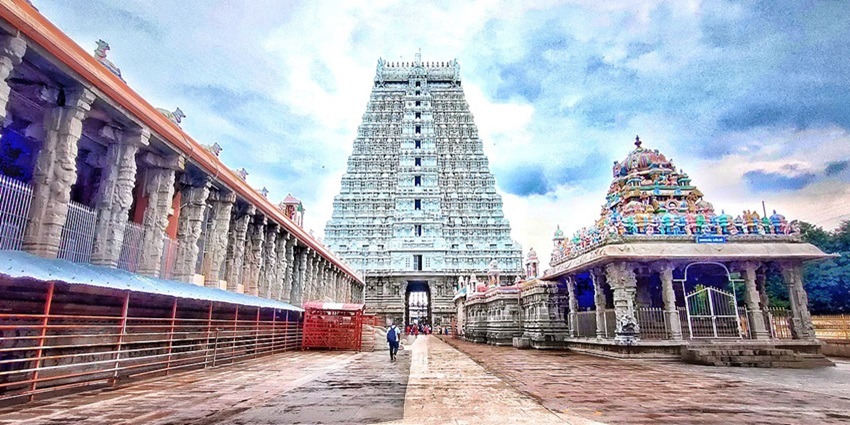
But the celebration begins earlier in the day. Before sunrise, in the inner sanctum of Annamalaiyar Temple, a sacred lamp called the Bharani Deepam is kindled—not with modern fire but by ancient fire-making methods through friction. This fire represents tapas—spiritual discipline—and the inner spark of awakening. As evening falls, the atmosphere becomes electric with devotion. Pilgrims and townspeople gather, their eyes turned to the summit. When the massive flame is lit atop the hill, it is as if Arunachala itself becomes a column of divine light. The mountain, the sky, and every beating heart are touched by Shiva’s presence.The celebration stretches over ten days. The temple town transforms into a vibrant field of devotion. Sacred processions of the Pancha Murthis—five divine forms of Shiva and Shakti—move through the streets to the sound of traditional drums and chants. At night, lamps glow on doorsteps and in shrines, symbolizing the divine presence within each soul.
The Skanda Upapurana praises this festival and speaks of liberation for those who witness the Deepam flame. This fire is more than light—it is a symbol of the divine Self within us all. Every flickering lamp reminds us: You are Light. You are That.
Saints like Ramana Maharshi saw Deepam not as a mere ritual but as a profound spiritual symbol. In silent reverence, they watched the flame and became one with its meaning. For those in Tiruvannamalai and for seekers across the world, Karthigai Deepam is not just a tradition—it is a reminder that even when the world seems dark, the flame of truth and divinity never fades. Arunachala promises that the light is always present—within and without.
Walking the Sacred Path: The Significance of Girivalam at Arunachala
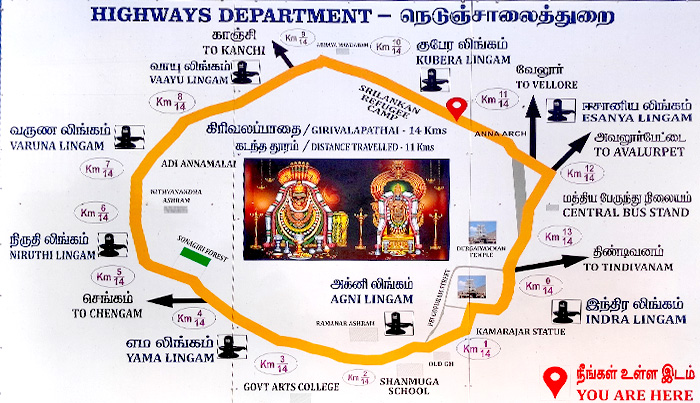
At Arunachala, even the moon seems to bow in reverence. The practice of Girivalam—the act of walking around the sacred hill—holds deep spiritual and cosmic importance, especially during the Full Moon (Poornima) and the festival of Deepam. Rooted in the ancient verses of the Skanda Purana, this timeless tradition blends myth, astrology, and devotion, turning the physical act of walking into a journey of divine connection.
Many first-time pilgrims are struck not only by the natural beauty along the 14-kilometre path, scattered flanked by banyan trees, roadside shrines and small temples, but also by the simplicity of the practice itself. Girivalam does not demand elaborate rituals or offerings. All it requires is one’s presence, each step becoming an act of release—letting go of burdens, thoughts, and attachments that no longer serve.
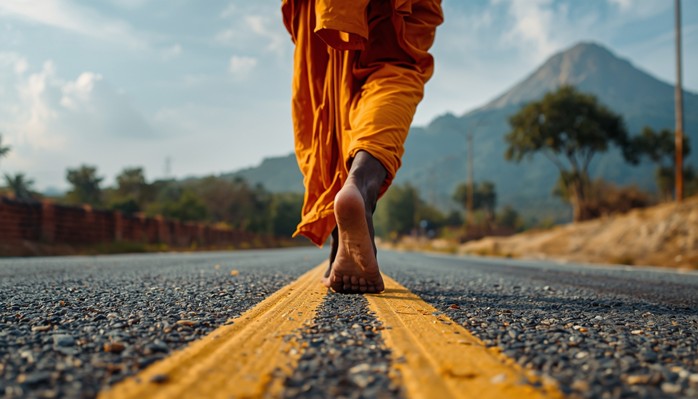
On any given full moon night, the path around Arunachala fills with people from all walks of life. Some walk in meditative silence, others chant mantras, and many simply absorb the energy of the sacred environment. Among them are families with children, monks in saffron robes, and elderly pilgrims who have likely performed this walk countless times over the years.
The journey around the hill fosters a deep connection to nature. Pilgrims often become acutely aware of the smallest details—the breeze through the trees, the crunch of gravel underfoot, the dance of sunlight across ancient rocks. Arunachala feels alive, not merely as a landscape, but as a living presence. There’s a quiet stillness that pervades the walk, a kind of silence that affirms everything is in its right place.
For centuries, this sacred circumambulation has remained a profound expression of devotion, humility, and unity with Arunachala—the hill that is worshipped as Shiva himself.
Ramana Maharshi: The Sage Who Amplified Arunachala’s Fame
Discovering the life of Sri Ramana Maharshi is often like stumbling upon a hidden treasure of spiritual insight. What makes his journey so relatable is its simplicity and authenticity. He wasn’t a distant, mystical figure lost in ancient scriptures—his path began when he was just a regular teenager, facing the same existential fears and questions that confront many at some point in life.
The defining moment in Ramana’s life occurred at the young age of sixteen. Alone in his room, he was suddenly gripped by an intense awareness of his own mortality. But instead of reacting with fear or distraction, he responded with rare courage. He lay down, closed his eyes, and consciously examined the experience of death. In doing so, he let go of his identification with the body and mind—only to realize that a deeper presence remained. That presence was pure awareness, untouched by death or time.
Soon after this inner awakening, Ramana left his family without a word and journeyed to Arunachala. He didn’t explain himself, nor did he have a plan—he was simply drawn there with an inner certainty. Once he arrived, he never left. For Ramana, Arunachala wasn’t just a pilgrimage site; it was his spiritual anchor, his guide, and ultimately his home.
He spent years in solitude, meditating in the caves of Arunachala, living a life stripped of comfort, and speaking only when necessary. He wasn’t seeking fame, followers, or recognition. His only aim was to remain in that silent, undisturbed awareness he had discovered within. Yet, despite his quiet nature, people began to gather around him. They were drawn to the peace he radiated and sought his guidance. Ramana, always gentle and clear, offered his insights with compassion.
To him, Arunachala wasn’t just a sacred landscape—it was the living presence of divine grace. He often spoke of the hill as a true spiritual teacher, one that communicated through silence. In his own words, “Arunachala is the best and most reliable teacher. If you sit quietly near it, it will teach you everything you need to know.”
What stands out about Ramana Maharshi’s life is how approachable and grounded it feels. He didn’t preach complex doctrines or insist on elaborate rituals. His teaching was direct and universal: turn inward, be still, and discover the truth of who you are. And for him, Arunachala was the perfect support in that sacred journey inward.
Sri Ramanasramam: A Living Legacy of the Sage
One of the most striking aspects of Sri Ramanasramam is its deep and ever-present connection to Arunachala. From nearly every corner of the ashram, the sacred hill can be seen standing tall in the background—a quiet, powerful presence that echoes Ramana Maharshi’s teaching that Arunachala is the true guru, silently guiding all who seek. Visitors to the ashram are often drawn not only to its peaceful atmosphere but also to the mountain itself. Many take time to hike up to the caves where Ramana spent years in deep meditation, while others engage in Girivalam—the sacred walk around the hill—as part of their spiritual journey. The bond between the ashram and Arunachala continues to inspire seekers from around the world, just as it did during Ramana’s lifetime.
A Modern Pilgrimage: Experiencing Tiruvannamalai Today
Even today, Arunachala stands as a powerful hub of spiritual energy, attracting millions of devotees and travelers each year. The mountain’s significance has reached far beyond India, largely due to the worldwide influence of Sri Ramana Maharshi’s teachings. Spiritual seekers from across the globe make their way to Tiruvannamalai, drawn by the magnetic presence of Arunachala and Sri Ramanasramam. Whether inspired by legend, history, or an inner calling, visitors find here a source of peace, clarity, and profound inner guidance.
Arunachala is the Self. Meditating on it removes all doubts and reveals the truth of existence.
Sri Ramana Maharshi