Tiruvannamalai, one of Tamil Nadu’s most revered temple towns, radiates the ageless spirit of devotion. As you enter, a green signboard announces your arrival. The gentle presence of wandering monks in saffron robes, garlands of roses and marigolds perfuming the air, and an invisible current of sacredness felt everywhere—all come together to welcome you.
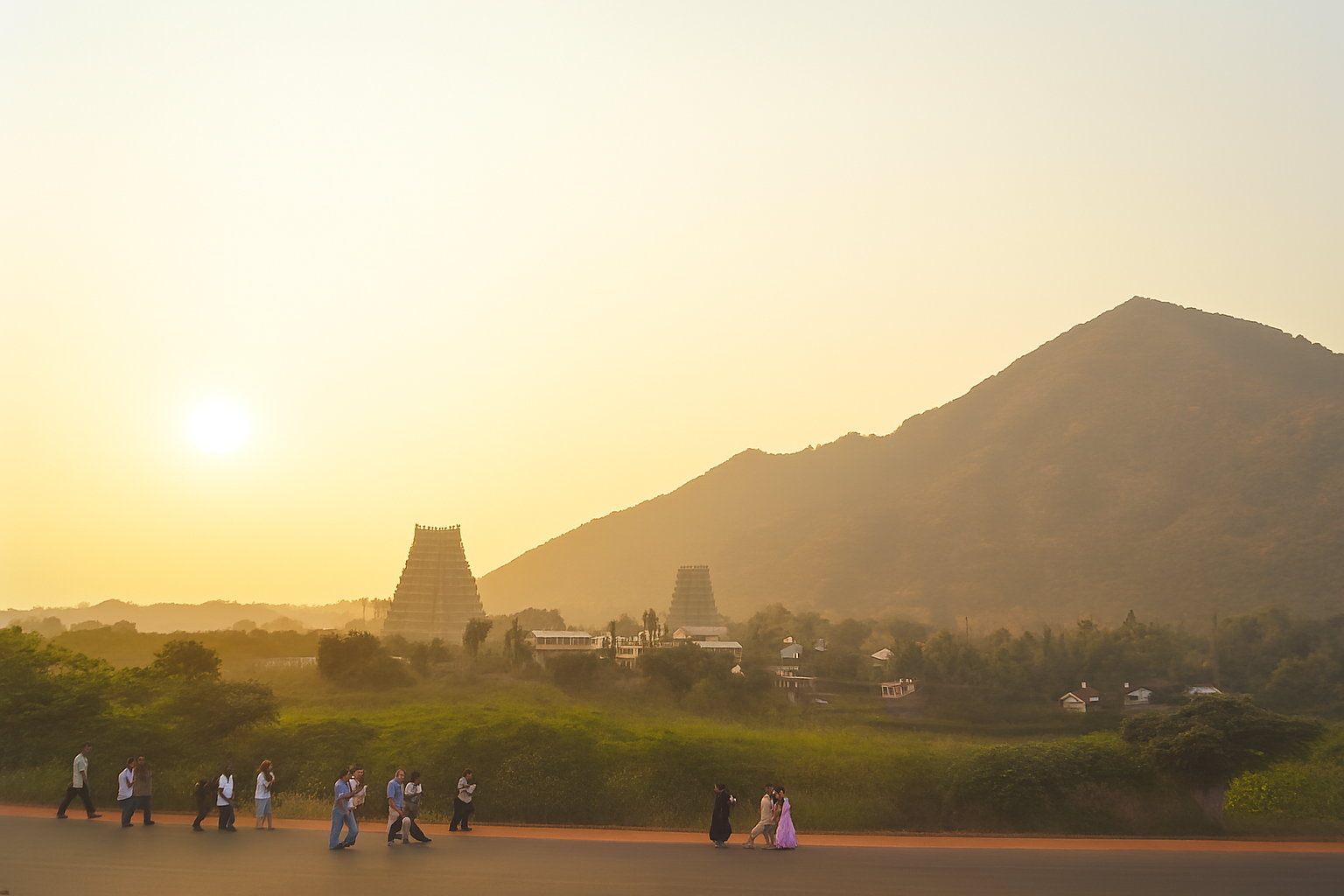
At the very center of Tiruvannamalai lies Arunachala Hill, a revered site of pilgrimage that can be seen from all parts of the town. Around its base stands the vast Annamalaiyar Temple, one of South India’s most important Shiva shrines, serving as a guiding light for countless devotees worldwide.
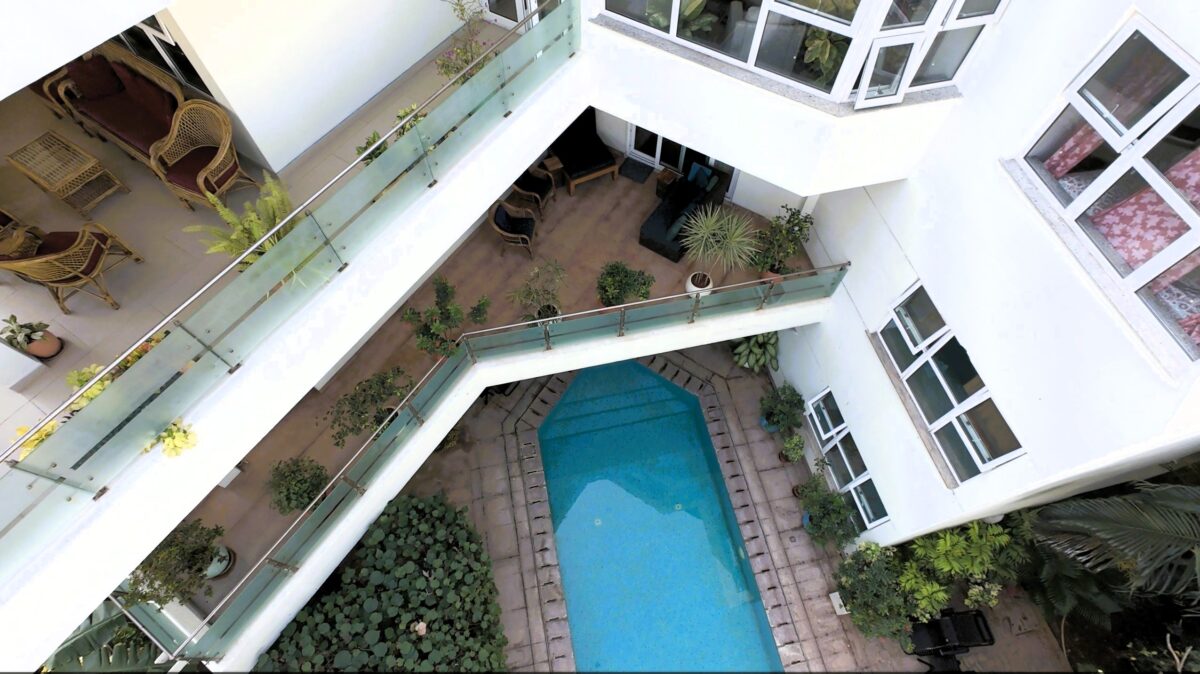
Set against the sacred backdrop of Arunachala Hill, Sangam Retreat House serves as an ideal base for those seeking to explore its profound spiritual energy. Just a short distance away are several must-visit ashrams, caves, and temples—each offering a unique experience to enrich your journey.
- Sri Ramanashram (800 m)
Just a short walk from Sangam Retreat House lies the renowned Sri Ramanashram, the ashram of Sri Ramana Maharshi , the sage of Arunachala. The atmosphere here is steeped in stillness, a silence that seems to echo the very presence of Maharshi himself. Established by Sri Bhagavan, this ashram has grown into a beacon of spiritual pilgrimage, welcoming seekers from around the world who come to immerse themselves in the path of self-inquiry and the timeless wisdom of Advaita.
From the moment Ramana arrived in Tiruvannamalai, he never left. He spent fifty-four uninterrupted years at the foot of Arunachala, embodying the stillness and clarity of the Self. Sri Ramana Maharshi’s life and teachings consistently pointed seekers toward the source of lasting happiness—their own true Self. His approach to spiritual realization is considered one of the most lucid and direct expressions of Advaita Vedanta, the non-dualistic wisdom tradition of India.
He taught that our essential nature is the Supreme Self, ever-present and unchanging. To awaken to this truth, one must turn inward and trace the origin of the ego—the ‘I-thought’—and rest in the Self. This method, known as Self-Enquiry, was the cornerstone of his guidance.
Ramana emphasized living life in a natural and effortless way. He did not advocate for renunciation or engagement in worldly activity, but rather encouraged freedom from the illusion of personal doership. Everything unfolds according to destiny, he said; the key is to remain free from the belief that “I am the doer.”
Through Self-Enquiry, one is gradually released from the fear, confusion, and suffering that arise from identifying with the ego. As this illusion dissolves, the seeker begins to experience true freedom and profound peace. The path leads from the seeming separation between self and world to the blissful recognition of one’s real nature. Even brief glimpses of Self-awareness reveal a Reality far beyond the limitations of ego—this living current of Awareness is ultimately known as the Self, Pure Consciousness.
Today, Sri Ramana Maharshi Samadhi Shrine is the final resting place for this great sage and marks the spot where Ramana’s physical body was interred after his death on April 14, 1950. It stands at the heart of the ashram and serves as a sacred and potent space for meditation, devotion, and inner silence.
- Seshadri Swamigal Ashram (1 km)
Almost adjacent to Sri Ramanashram is the Seshadri Swamigal Ashram. Known for his intense devotion and mystical powers, Seshadri Swamigal is lovingly called the “Saint with a golden hand.” Devotees often experience blessings of protection and healing here. The ashram is vibrant with daily pujas, chanting, and the compassionate presence of the saint’s samadhi.
Arriving in Arunachala six years before Sri Ramana Maharshi, Seshadri Swamigal played a pivotal role in Ramana’s early life. It was he who discovered the young sage meditating in the Pathala Linga of the Arunachaleswara Temple (the main temple in Tiruvannamalai), shielding him from harm and quietly introducing him to the world. The two were contemporaries, each embodying a unique spiritual radiance.
Seshadri Swamigal was a ascetic yogi of exceptional depth, known for his siddhis and psychic abilities. Devotees who approached him with sincerity often experienced miraculous healings and transformative visions—both in dreams and waking states. His spiritual presence was said to fulfill heartfelt desires and awaken deep devotion.
Throughout his life, Seshadri Swamigal emphasized the supreme grace of Arunachala. He taught that the hill itself is the embodiment of Shiva, declaring, “This is Shiva Lingam. It is enough to worship this. One can become spiritually enlightened and attain liberation.” He also stressed the power of giripradakshina—the sacred circumambulation of the hill—urging devotees to perform it especially on Tuesdays, as it would invoke profound devotion and spiritual awakening.
Locals affectionately referred to Sri Seshadri Swamigal as Mother Parvathi, and Sri Ramana Maharshi as Skanda (Lord Subramanya), reflecting the divine bond they believed existed between the two saints. On one occasion, a devotee remarked to Sri Ramana that people often called Seshadri Swamigal a madman. With a gentle smile, Ramana replied, “There are three madmen in Arunachala—Seshadri, Arunachaleswarar, and myself.”
Sri Ramana once observed, “Sri Seshadri does not allow people to come near him. Here, all are coming,” highlighting the contrasting ways in which the two saints engaged with devotees.
On January 4, 1929, Sri Seshadri Swamigal attained Mahasamadhi, and his body was taken out in a grand procession attended by a vast crowd of mourners and devotees. In a rare and poignant gesture, Sri Ramana Maharshi descended from the slopes of Arunachala to join the funeral procession—a significant moment, as he seldom left the sacred hill.
Among the people of Arunachala, Seshadri Swamigal was lovingly called “Anna” (elder brother), while Sri Ramana was referred to as “Thambi” (younger brother), reflecting the familial affection and spiritual kinship they shared. Sri Ramana personally oversaw the construction of Sri Seshadri Swamigal’s Samadhi shrine, ensuring it was built with care and devotion.
Later, in a gesture that further affirmed their spiritual unity, Sri Ramana chose to reside near the Ashram of Sri Seshadri Swamigal, embodying the sentiment held by the local devotees—that they were none other than Muruga and Kamakshi, divine son and mother, manifest in human form.
Today, his samadhi is enshrined within the serene grounds of Sri Seshadri Ashram. Though he has left his physical form, his presence continues to guide, bless, and uplift those who seek his grace. His own journey led him to Arunachala, and it is to this sacred hill that he directs all seekers—to realize life’s highest purpose and attain eternal bliss.
- Skanda Ashram & Virupaksha Cave (2.3 km via Skandashram Trail)
Climbing partway up Arunachala Hill leads to two extraordinary spots: Skanda Ashram and Virupaksha Cave. Ramana Maharshi lived in Virupaksha Cave for nearly 17 years in deep silence. It was during his time in this cave that foundational works such as Who am I? and Self-Inquiry emerged. For this reason, many devotees consider it a sacred site that must be visited. The atmosphere within the cave continues to offer a deeply meditative experience, often described as profoundly transformative by those who sit in its stillness.
Skanda Ashram, slightly higher up the hill, also housed Ramana and his early disciples. Ramana lived at Skandashram from 1915 to 1922. It was here that his mother, Alagammal, came to live with him and began cooking meals on-site for the growing community, replacing the earlier practice of carrying prepared food up to the cave, as had been done since the earliest years. With the establishment of Skandashram, the transition to the larger cave marked the true beginning of what would become the Ramana Ashram. At that time, a small circle of devotees gathered around Sri Ramana Maharshi, sustaining themselves on food offered by visitors and those devoted to him. As the number of followers steadily increased, the practical need to prepare meals regularly for both residents and guests became apparent, prompting a search for more water and space to build a kitchen.
To meet these growing needs, the devotees constructed a modest structure around the Skandashram cave. This included a separate room for Ramana’s mother, ensuring her comfort and care. The space was not only designed to support the human community but also extended its hospitality to the animals who lived alongside Ramana and the early ashramites, sharing in the food and companionship of the ashram life.
Both places radiate a stillness that makes meditation natural and effortless. The short trek uphill rewards seekers not only with sacred energy but also with breathtaking views of the temple town below.
- Yogi Ramsurat Kumar Ashram ( 700 m)
Known as the “Beggar Saint of Tiruvannamalai,” Yogi Ramsurat Kumar lived a life of utter surrender, radiating divine madness and grace. His ashram today is a vast prayerful space where his presence can still be deeply felt. Devotees chant, sing bhajans, and sit in silence, remembering the saint whose every breath was dedicated to the Divine.
Yogi Ramsuratkumar’s divine utterances, though infrequent, flowed spontaneously and carried profound depth. His very being was his teaching—an immense spiritual presence in Tiruvannamalai, radiating the grace and essence of the Divine. His core message was unwavering: “Everything is my Father. I am nothing, nobody is anything, nothing is anything—there is only Him.” He often reminded devotees, “Don’t pay attention to this beggar,” while also affirming, “Whatever this beggar does has implications all over the universe.”
Miracles frequently unfolded around him, earning him the affectionate title “the God-child of Tiruvannamalai.” People from across India would come seeking his blessings for various life concerns—whether yearning for children, hoping for success in business, or seeking relief from suffering. His response was simple yet powerful: “Ram! Ram!” And their prayers were often fulfilled. Yogiji never made a spectacle of these events; his grace was quiet, natural, and profound.
In time, a large ashram dedicated to Yogi Ramsuratkumar was built, honoring his legacy and continuing to serve as a sanctuary for seekers drawn to his presence and teachings.
- Adi Annamalai Temple ( 6.4 km)
Situated at the foothill on the Giri Valam path (the sacred 14 km walk circumambulating the road around Arunachala), the Adi Annamalai Temple is an ancient shrine older than the grand temple in town. Pilgrims stop here during their Giri Valam to bow down before the Lord in his primal form.
Adi Annamalai Temple is regarded as the oldest temple in the region surrounding Tiruvannamalai. Historical accounts suggest it was constructed at least a hundred years before work began on the Arunachaleswara Temple, making it nearly 2,000 years old. The name “Adi Annamalai” translates to “original” or “ancient” Annamalai, referring to Arunachaleswarar.
Though modest in scale—covering just about an acre—it holds immense spiritual significance, especially when compared to the expansive 25-acre Arunachaleswara Temple located on the southeastern side of Arunachala Hill. The view of the sacred hill from Adi Annamalai is revered as Siva Yoga Muka Darshan, a divine aspect witnessed by the great Siddha Thirumoolar.
Bhagavan Sri Ramana Maharshi would often stay at this temple for two to three nights during his Giri Valam. He once shared that while at Adi Annamalai, he heard the celestial chanting of the Sama Veda, further deepening the temple’s mystical aura and spiritual legacy. The temple is simple yet powerful, carrying the weight of centuries of devotion.
- Annamalaiyar Main Temple ( 2.5 km)
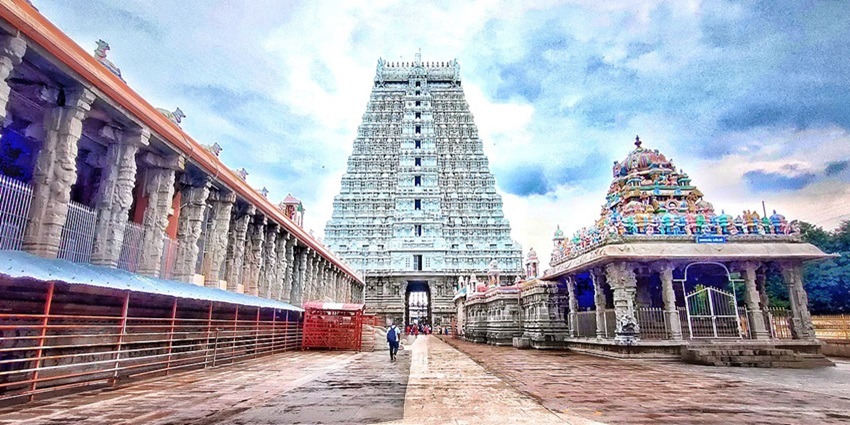
The Arunachaleswarar Temple, the main temple in Tiruvannamalai holds a revered place in Tamil Shaivite tradition, having been celebrated in the Tevaram hymns—devotional verses composed by the three great Saivite saints between the 7th and 9th centuries CE. Saints Thirugnana Sambandar, Appar (Thirunavukkarasar), and Manickavasagar sang in praise of Lord Shiva here, while Arunagirinathar offered his devotional Thiruppugazh verses at this sacred site.
This temple is one of the Pancha Bhootha Sthalams, representing the element of fire (Agni Lingam). According to legend, Lord Shiva manifested as an infinite column of fire at this location, a form that neither Brahma nor Vishnu could trace to its origin or end. Eventually, Shiva took the form of a Sivalingam at the base of Arunachala Hill, where the Annamalaiyar Temple now stands. It is believed that even the remembrance of Lord Arunachaleswarar can grant Mukti (liberation).
The temple’s presiding deity is Arunachaleshwara, also known as Annamalaiyar, with Goddess Parvathi worshipped as Unnamalai Amman. The temple is renowned for its majestic architecture, deep-rooted spiritual traditions and vibrant festivals. Its greatness is reflected in its frequent mention in classical Tamil literature, including the Tevaram and Thiruvasagam.
Recognized as a Paadal Petra Sthalam (refers to a group of sacred Shiva temples in Tamil Nadu and parts of South India that have been glorified in the Tevaram hymns), the temple is one of the 275 sacred Shiva temples glorified by the Nayanmars, the Tamil saint-poets.
Spread across an impressive 25-acre complex, the temple features a towering Rajagopuram that rises 217 feet with 11 stories. This monumental gateway was initiated by King Krishna Devaraya of the Vijayanagar Empire and later completed by Sevappa Nayaka of Thanjavur. The temple includes nine gopurams (towers), nine prakarams (sacred enclosures), and is surrounded by four massive stone walls, giving it the appearance of a fortress. Inside, the temple houses 56 courtyards, two sacred tanks, and a thousand-pillared hall, showcasing the grandeur of Dravidian architecture. One of its most spiritually significant spots is the Pathala Lingam, an underground shrine where Bhagavan Sri Ramana Maharshi is believed to have performed intense penance.
Every full moon night, thousands of pilgrims walk the Giri Valam, circling the temple and Arunachala Hill with devotion. Visiting this temple is essential for anyone seeking to feel the pulse of Tiruvannamalai.
- Ashta Lingams on Girivalam Road (Situated at intervals around the hill)
Along the Giri Valam route lie the sacred Ashta Lingams — eight shrines each representing a direction and associated with a planet. Pilgrims pause at these shrines during their circumambulation of Arunachala, offering prayers for balance, protection, and blessings. Stopping at each lingam connects the journey to the cosmic rhythm that Tiruvannamalai embodies. Read More
- Sri Saibaba Dhyana Mandiram (6.9 km)
For devotees of Sri Sai Baba of Shirdi, the Saibaba Dhyana Mandiram on the sacred Girivalam path in Tiruvannamalai offers a haven of peace, devotion, and divine presence. The soft sounds of Baba’s namam provide a backdrop to the simple atmosphere in the temple that allows so many
pilgrims to sit in the presence and feel the compassionate gaze of Sai Baba guiding their spiritual journey around Arunachala Hill.
This Mandir is the realization of a vision held by Sri Sainathuni Sarath Babuji, who, as a young man, envisioned a beautiful Sai temple along the Giripradakshina route. The temple was inaugurated on March 19, 2014, and its design was shaped following Sri Babuji’s guidance. The positioning and elevation of the statue were deliberately chosen so that Sai Baba would be visible to those walking the Girivalam, offering darshan from afar. The steps that gently lead devotees up into the open entrance of the hall are nine in number as this held a particular significance in Baba’s life and the use of red and white stone make a playful reference to painted stripes on
traditional South India temples.
The temple’s open-air design allows devotees to circumambulate the statue freely, with no pillars obstructing the view, creating a seamless and immersive experience. The statue itself was carved by Rajiv Talim using the original model made by his grandfather, the celebrated Bombay sculptor
Balaji Vasantrao Talim in pure white marble from the same quarries in Carrara, Italy. The work was done in Talim’s studio in Mumbai and It was Sri Babuji’s wish that it be as close as possible to a pure copy of the original. After the statue was carved, it was taken to Shirdi, where it was placed at both Sai Baba’s samadhi and Sri Babuji’s samadhi, before being transported to Tiruvannamalai. Behind the statue screen stands the Akhanda deepam, the perpetual flame that was originally lit
by Sri Babuji himself in Shirdi. The spark of the flame was taken from the embers of Sai Baba’s dhuni and it has been kept alight in Shirdi ever since. That flame was then carefully carried to Tiruvannamalai and has since burned uninterruptedly under its glass dome.
The temple’s construction was a labor of love, made possible through the devotion of countless followers who joined in the physical work as a way to express the depth of their love for both Sri Sri Baba and Sri Babuji. Although Sri Babuji passed away in 2010 and did not witness the
completion of the Mandir, his presence is deeply felt throughout.
Behind the Mandir lies Haritachala, a serene expanse of land that serves as both an organic farm and a retreat center for members of Sri Babuji’s sangha. A few times a year, silent retreats are held here, led by Sruti, Sri Babuji’s daughter, who continues to uphold and share his teachings with
deep dedication. Haritachala and the temple are solar-powered, reflecting a thoughtful integration of sustainability and spirituality that was close to Sri Babuji’s heart.
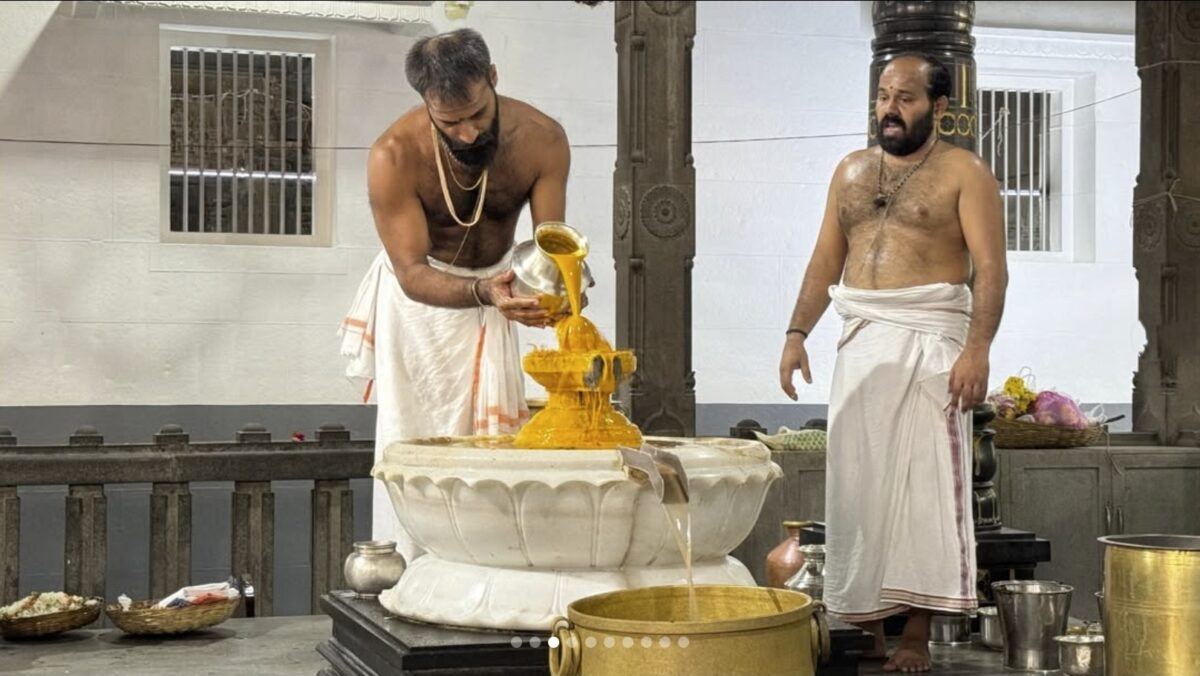
Each day, the statue is ritually bathed, with four pujas and offerings performed, culminating in an Arati at 8pm, mirroring the devotional rhythm of Shirdi. The statue is carved with Baba wearing his customary kafni and head cloth but uniquely here, unlike other depictions of him, shawls and scarves are rarely used to adorn him – an elegant and distinctive feature of this temple. On Full Moon nights, the temple remains open for 24 hours, welcoming pilgrims into its tranquil embrace under the moonlit sky, offering uninterrupted darshan and deep spiritual connection.
A Journey Within and Without
Walking out of Sangam Retreat House, you step directly into a living mandala of sacred sites. From the profound silence of Sri Ramanashram to the timeless majesty of the Annamalaiyar Temple, from the caves where Ramana sat in stillness to the humble ashrams of saints, every place holds a unique fragrance of truth.
A spiritual journey here is not about sightseeing — it is about being seen by Arunachala, being stripped of illusions and returning to the simple recognition: the Self alone is Real.