Have you ever wondered what makes certain places feel sacred the moment you step foot on them? Arunachala, the majestic hill in Tamil Nadu, India, is one such mystical destination where ancient stories come alive in every stone and shadow. This isn’t just another mountain—it’s a living repository of divine tales, spiritual encounters, and timeless traditions that have shaped the faith of millions.
The reader is invited on a journey through the fascinating legends that surround this holy peak. The legends surrounding Arunachala are among the most profound in Hindu mythology. They speak not only of divine manifestations but also of deep spiritual truths: the dissolution of ego, the recognition of the Self, and the stillness that lies beyond creation.
This blog explores the mythology, symbolism, and living legacy of Arunachala — the Mountain of Fire that continues to call inward every soul that beholds it.
Origins and Creation Legends of Arunachala
A. The Column of Fire: Shiva’s Infinite Light
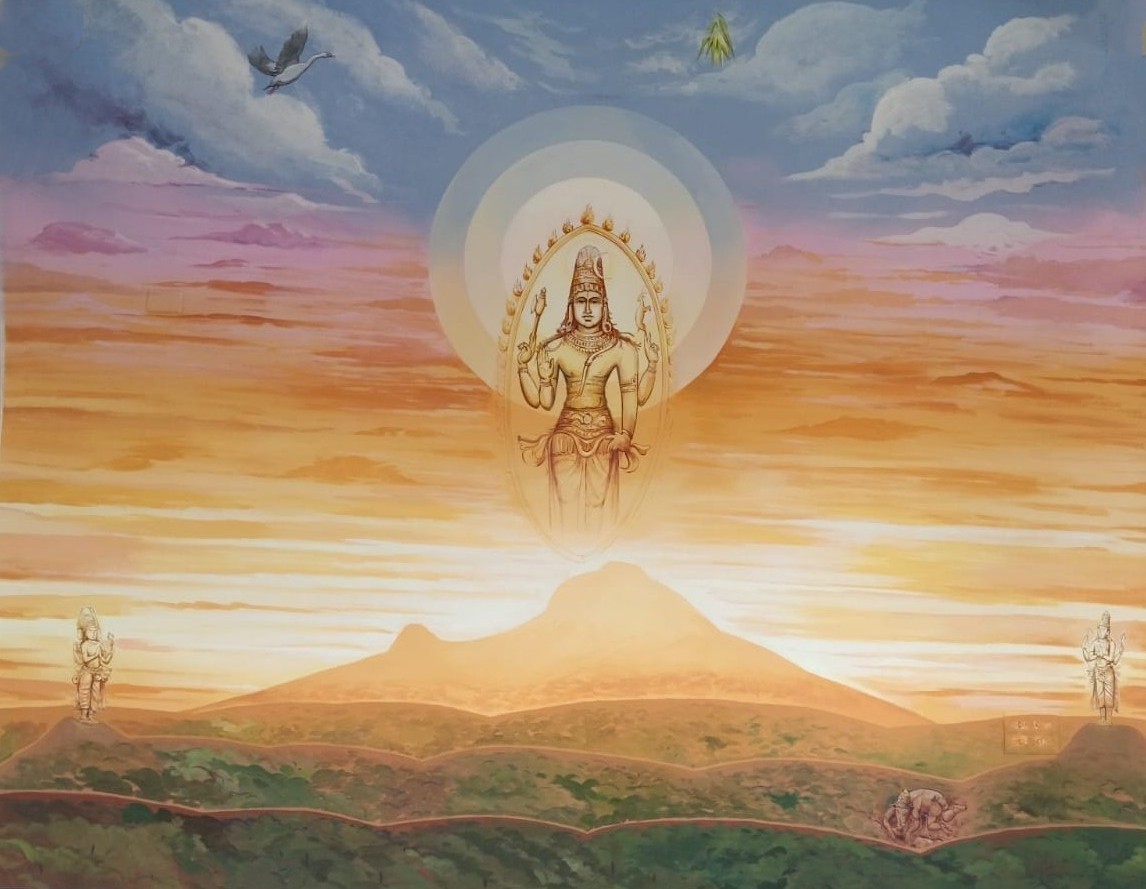
Picture this: a pillar of blazing light stretching infinitely upward and downward, so brilliant that it defies comprehension. According to ancient Hindu texts, this is how Arunachala first appeared to the world. The mountain is believed to be the physical manifestation of Lord Shiva himself, not as a statue or symbol, but as the very essence of divine consciousness taking the form of stone and earth.
The story goes that Shiva appeared as this endless column of fire—called the “Jyotirlinga”—to demonstrate his supreme nature. Unlike other sacred sites where Shiva is worshipped through man-made lingams, Arunachala is considered a “natural lingam,” formed by divine will rather than human hands. Walking around this mountain, many pilgrims report feeling an inexplicable sense of peace, as if the very rocks are radiating spiritual energy.
It is considered fascinating how this legend weaves together the physical and metaphysical realms. The idea that a mountain could be divine consciousness in solid form challenges our usual way of thinking about matter and spirit as separate things.
B. The Contest Between Brahma and Vishnu
Here’s where the story gets interesting. The creation of Arunachala stems from a cosmic argument—yes, even gods have their disagreements! Brahma, the creator god, and Vishnu, the preserver, got into a heated debate about who was superior. Their egos clashed so intensely that it threatened the balance of the universe.
To settle this dispute, Shiva manifested as the infinite column of fire. He challenged both gods to find either the top or bottom of this fiery pillar. Vishnu, in his humility, searched downward for thousands of years but couldn’t find the base. He eventually gave up and admitted defeat. Brahma, however, flew upward and—here’s the twist—lied about finding the top, claiming a ketaki flower as proof.
Shiva, knowing the truth, cursed Brahma to never be worshipped in temples (which explains why there are so few Brahma temples compared to Shiva and Vishnu temples). To cool down this cosmic fire and restore peace, Shiva agreed to take the form of Arunachala Mountain. It’s like the ultimate divine intervention, transforming destructive energy into a source of spiritual nourishment.
C. Geological Formation Through Divine Intervention
While geology tells us about tectonic movements and rock formations over millions of years, the spiritual tradition offers a different perspective. According to devotees, Arunachala wasn’t formed through natural processes alone but through divine intention crystallized into matter.
The mountain is primarily composed of ancient granite, some of the oldest rock formations on Earth. But believers see something more profound in its structure. The mountain’s distinctive form, its powerful attraction for spiritual seekers, and the mystical events associated with it are regarded as signs of its sacred origin.
It is striking to many how scientific and spiritual perspectives can coexist without contradiction. Perhaps the divine works through natural processes, using geological forces to create sacred spaces that resonate with human consciousness in special ways.
Summary
Arunachala stands as one of India’s most revered spiritual destinations, where ancient mythology seamlessly blends with living traditions. The mountain’s legends span from primordial creation stories involving the trinity of Hindu gods to contemporary accounts of spiritual transformation. These interconnected tales create a rich narrative that continues to draw pilgrims, scholars, and seekers from around the world.
The enduring power of Arunachala’s mythology lies not merely in its ancient origins, but in its capacity to inspire profound spiritual experiences across generations. The mountain’s greatest teaching might be its invitation to experience the sacred directly, beyond the stories and rituals, in the depths of our own being where all legends ultimately point.