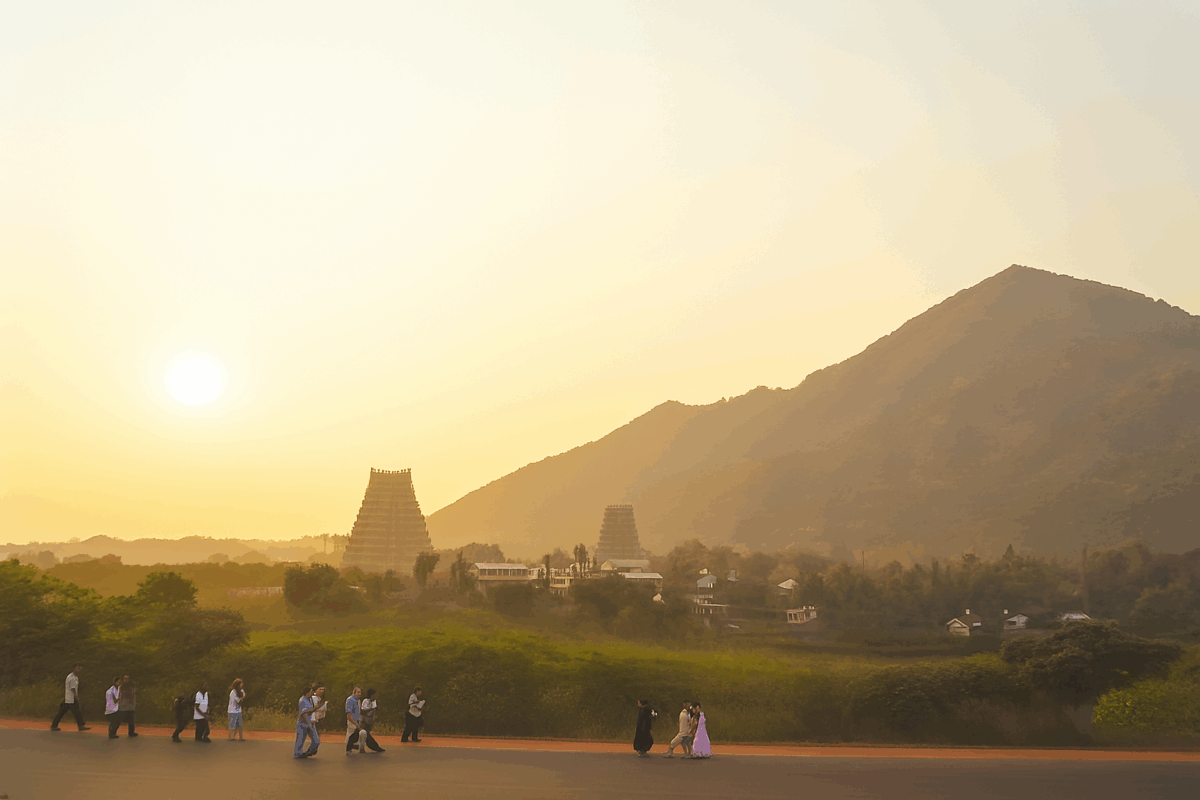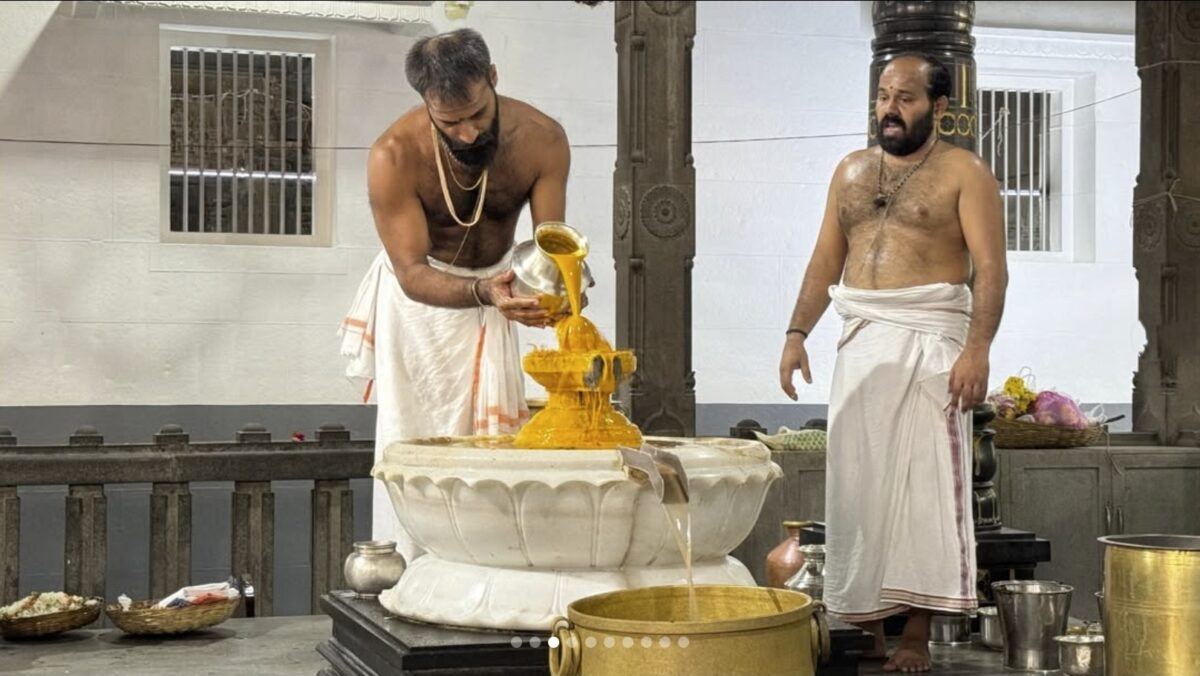
To walk around Arunachala is not merely to cover distance, it is to enter a timeless dialogue between the seeker and the sacred. Known locally as Girivalam, this ancient practice has been carried forward for centuries by saints, householders, pilgrims, and silent wanderers alike. Each step taken around the holy hill of Arunachala is believed to mirror an inward turning, a gradual circumambulation of the Self itself.
- The Sacred Tradition of Circumambulation
A. Origins and Etymology of Girivalam and Pradakshina
The word Girivalam comes from Tamil: giri (mountain) and valam (to go around). In Sanskrit, the equivalent practice is called Pradakshina, meaning “moving to the right.” Both terms point to the same sacred act— walking reverentially around a holy object, place, or presence. In Indian spiritual traditions, circumambulation symbolizes placing the divine at the center of one’s life, allowing all movement to arise around that still point. Hindu mythology traces its origin to Ganesha, who first circled his parents, Shiva and Parvati, declaring them the universe. Since then, Pradakshina has symbolized devotion and recognition of divine presence. In Tiruvannamalai, this practice takes the form of circumambulation of Arunachala Hill, revered as Lord Shiva himself.
B. Cross-Cultural Mountain Walking Practices Worldwide
Sacred walking around mountains is not unique to India. In Tibet, pilgrims perform the kora around Mount Kailash; in Japan, devotees walk the Kumano Kōdō mountain routes; and in ancient Celtic traditions, hills and stone circles were circled in ritual ways. Across cultures, mountains have been seen as bridges between earth and sky—natural temples that draw human beings into humility, reverence, and silence.
C. The Spiritual Significance of Clockwise Movement
Walking clockwise — keeping the sacred presence on one’s right— is deeply symbolic. The right side has traditionally been associated with auspiciousness, order, and harmony. Spiritually, clockwise movement reflects alignment with the natural rhythms of life and consciousness, reinforcing the sense of surrender to a greater cosmic order.
- Arunachala: The Heart of Tamil Girivalam
A. The Holy Hill of Tiruvannamalai and Its Religious Importance
Arunachala is revered as a manifestation of Shiva in the form of fire (Agni Lingam). Saints like Bhagavan Sri Ramana Maharshi spoke of Arunachala not as a symbol, but as a living presence — consciousness itself taking the form of a mountain. For countless devotees, simply being in its vicinity is considered transformative.
In ‘My Recollections of Bhagavan’, Devaraja Mudaliar admits his reluctance to perform Pradakshina, though he sensed its significance and questioned Bhagavan about it. Bhagavan replied: “For everybody it is good to make circuit of the hill. It does not even matter whether one has faith in this Pradakshina or not, just as fire will burn all who touch it whether they believe it will or not, so the hill will do good to all those who go round it.” He also told him: “Why are you so concerned with all these questions about the efficacy of going round the hill? Whatever else you may or may not get, you will at least have the benefit of the physical exercise.” On another occasion Bhagavan said: “Go round the hill once. You will see that it will attract you.” Mudaliar observed that Bhagavan never discouraged anyone from Pradakshina, but at the most remarked : “You can go slowly”.
In ‘Letters from Ramanasramam’, Sri Bhagavan said: “The greatness of this Giri Pradakshina has been described at length in ‘Arunachala Puranam’. Lord Nandikesa asked Sadasiva a similar question and Sadasiva narrated as follows: ‘To go round this hill is good. The word ‘Pradakshina’ has a typical meaning. The letter ‘Pra’ stands for removal of all kinds of sins; ‘da’ stands for fulfilling the desires; ‘kshi’ stands for freedom from future births; ‘na’ stands for giving deliverance through Jnana.’” Bhagavan added that the joy of Pradakshina is beyond description: the body tires, senses lose strength, activities turn inward, and one enters meditation. Continued walking harmonizes the body like in asana and improves health. Besides this, there are several varieties of medicinal herbs on the hill. The air that passes over those herbs is good for the lungs.
Sri Seshadri Swamigal, the ascetic yogi of Tiruvannamalai renowned for his intense devotion, siddhis, and psychic abilities, emphasized the power of Giripradakshina and encouraged devotees to perform it especially on Tuesdays to awaken deep devotion and spiritual insight.
B. Physical Description of the 14-Kilometer Circumambulation Route
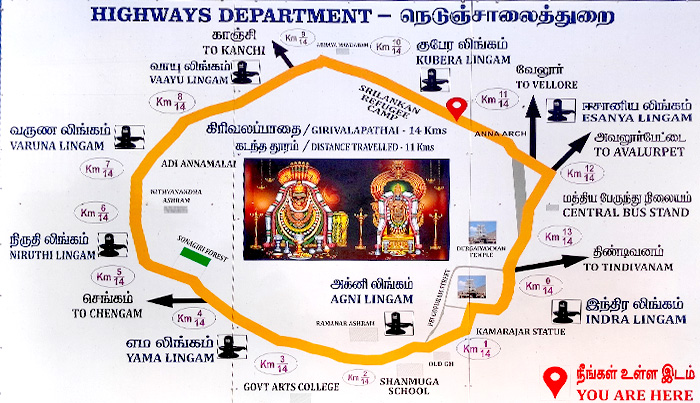
The Girivalam path is approximately 14 kilometers long, encircling the base of the hill. The road is mostly flat and well-defined, passing through residential areas, open stretches, shaded avenues, and busy pilgrimage zones.
Adimudi Siddhar, a mystic yogi, is credited with creating the Girivalam path around Arunachala Hill. He instructed locals to roll his straw wrapped body around the hill, marking a six foot wide route that channelled its sacred energy for healing. His samadhi, opposite Gautama Maharishi’s ashram, remains a revered stop for devotees.
While the walk can be completed in three to four hours, many choose to move slowly, allowing pauses for rest, prayer, or quiet observation.
C. Sacred Sites and Temples Along the Arunachala Path
Along the Girivalam route are eight Lingams, ancient shrines, ashrams, and small roadside temples, each carrying its own history and spiritual energy. Pilgrims pause at these points to offer prayers or stand in silence before continuing their journey.
One significant stop is Unnamalai, the “fasting mountain,” associated with Goddess Parvati. Guided by Gautama Maharishi, she observed a 40‑day fast here to unite with Lord Shiva, making this section especially sacred for devotion and austerity. Unnamalai thus embodies the spirit of fasting and penance.
The stretch from Niruthi Lingam to Surya Lingam is renowned for Annadanam (food offerings), rooted in the belief that Goddess Annapurna blesses devotees with nourishment after their fast. For pilgrims, Girivalam represents both spiritual awakening and physical sustenance, with Annadanam offered in honor of the goddess who nourishes all beings.
- The Ritual Framework and Traditional Practices
A. Preparation Rituals and Mental Readiness Before Walking
Traditionally, Girivalam begins with an inner intention. Some pilgrims fast lightly, others bathe before starting, and many set aside personal concerns, approaching the walk as an offering rather than an achievement. The emphasis is on humility and receptivity.
B. Proper Conduct and Behavioral Guidelines During Circumambulation
The walk is ideally done with awareness — avoiding loud conversation, distractions, or haste. Many maintain silence, chant softly, or keep attention on the rhythm of their breath and steps. Respect for fellow walkers, animals, and the land itself is considered part of the practice.
C. Post-Walk Observances
Upon completing the circumambulation, devotees often pause in gratitude —sometimes at a temple, sometimes quietly within themselves. The essence lies in acknowledging the inner stillness or insight that may have surfaced during the walk.
- Seasonal Rhythms and Festival Connections
A. Kartik Deepam Festival and Peak Pilgrimage Season
Karthigai Deepam is the most significant festival of Arunachala, celebrated each year in Tiruvannamalai during the Tamil month of Karthigai (mid‑November to mid‑December). A towering flame is lit atop the hill, glowing for days as a radiant symbol of divinity. Nearly four million pilgrims are drawn to Tiruvannamalai during this period, many of them performing Girivalam throughout the night, moving in reverence around the sacred hill. Maha Shivaratri is another peak occasion, when devotees fast and worship Lord Shiva throughout the night. Temples and homes resonate with rituals, and the atmosphere is charged with profound energy. On this sacred night, many also undertake Giripradakshina — a practice that Ramana Maharshi affirmed as true worship of the Lord of boundless compassion.
B. Full Moon Walks and Their Enhanced Spiritual Significance
Full Moon Day, marks a turning point in each lunar cycle, dividing the waxing Shukla Paksha from the waning Krishna Paksha. On this spiritually charged night, between 50,000 and 500,000 pilgrims gather in Tiruvannamalai to walk the sacred Girivalam path around Arunachala, drawn by the belief that the hill’s energy radiates most powerfully under the full moon’s glow. Full moon (Pournami) nights are especially popular for Girivalam, with the soft moonlight, cooler air, and collective devotion creating an atmosphere described as deeply meditative.
C. Daily Practice Cycles and Year-Round Devotional Patterns
Beyond festivals, Girivalam continues quietly every day. Local residents, long-term seekers, and visiting pilgrims keep the tradition alive year-round, making it both an extraordinary and ordinary aspect of life in Tiruvannamalai.
- The Community of Walkers and Social Dynamics
For many locals, Girivalam is woven into daily life—a morning or evening walk, a moment of prayer, or a lifelong rhythm rather than a special event.
Visitors come with varied intentions: devotion, curiosity, healing, or inner inquiry. While motivations differ, the shared path gently levels distinctions, inviting everyone into the same quiet movement.
- Health Benefits of Long-Distance Walking
The legend of Arunagirinathar tells of a sage devoted to Lord Muruga in Tiruvannamalai around 550 BC. At the Arunachaleshwarar Temple, Muruga is honored at the shrine Khambattu Ilayanaar, where he once appeared from a pillar. Tasked with curing a king’s blindness, Arunagirinathar transformed into a parrot and flew to heaven to fetch the divine Parijata flower, famed for its healing powers. His enemies burned his body, eventually leaving him in parrot form, and tradition holds that he still resides in the temple’s Kili Gopuram (Parrot Tower). The flower is believed to have fallen on Arunachala Hill, becoming active during the full moon and infusing the mountain with healing energy. This belief inspires millions to perform Girivalam Pradakshina during full moon nights, seeking both Shiva’s blessings and the flower’s sacred power.
Physically, Girivalam strengthens endurance, circulation, and overall vitality. At the same time, it can be demanding—especially in heat—requiring pacing, hydration, and self-awareness. The steady rhythm of walking often quiets mental noise. Repetitive movement can induce a meditative state where thoughts soften and attention naturally settles into the present moment. As fatigue arises and passes, many discover an inner resilience. This mirrors spiritual life itself—learning to remain present, receptive, and surrendered despite discomfort or resistance.
Summary
Girivalam around Arunachala is far more than a physical journey. It is a sacred choreography of body, mind, and consciousness—an ancient practice that continues to invite seekers into stillness through movement. Each step around the hill gently reflects an inward circling, reminding the walker that what is sought outwardly is already present at the center. The tradition continues to evolve while maintaining its essential character, offering both residents and visitors a tangible way to engage with sacred geography and personal transformation.
In walking Arunachala, one does not merely go around a mountain—one is slowly brought home.
FAQs
Q: How long does it take to complete the Arunachala Girivalam?
A: The complete 14-kilometer circumambulation typically takes 3-5 hours depending on walking pace, crowd levels, and time spent at various temples and rest stops along the route.
Q: Are there specific rules about what to wear or bring during Girivalam?
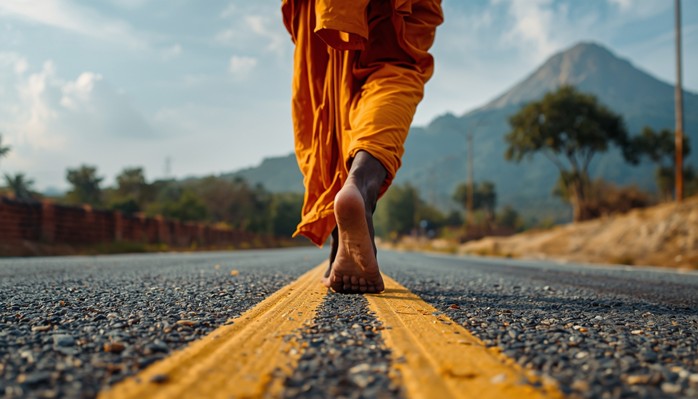
A: While there are no strict dress codes, modest clothing is recommended. Many pilgrims walk barefoot as a mark of respect, though comfortable walking shoes are acceptable. Carrying water and small offerings for temples is common practice.
Q: Can people of any religion or background participate in Girivalam?
A: Yes, the practice is generally open to people of all backgrounds. The emphasis is on respectful participation and sincere intention rather than specific religious affiliation.
Q: What is the difference between doing Girivalam during festivals versus regular days?
A: Festival periods, especially during Kartik Deepam, see much larger crowds and enhanced ceremonial activities, but also longer completion times. Regular days offer a more peaceful experience with easier access to temples and rest areas.